


Why Choose Organic? Please share
Our Organic Farms Video
Organic Info Sheet 
If you think cotton is a safe choice because it is 'natural', think again.
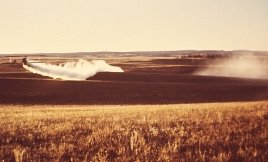 Crop Duster Plane Spraying Insecticidal Dust Over Vast Fields. |
Until about 50 years ago, cotton-growing mainly involved sustainable techniques: it did not permanently deplete resources or
create a health hazard. Today, however, the pesticides used on 'conventional' cotton increasingly threaten people, wildlife
and the environment. Most pesticides were originally developed as toxic nerve agents during WWII and it is no wonder they
have been linked to many forms of cancers.
|
A year 2000 USDA study revealed that eighty-four million pounds of pesticides were sprayed on cotton in the U.S.A, ranking it second behind corn. Some of these toxic chemicals include the infamous defoliant Paraquat and insecticides like Parathion which is 60 times more toxic that DDT! In fact, the EPA considers 7 of the top 15 pesticides used on cotton as "likely" or "known" human carcinogens.
Ironically, it is estimated that less than 10% of the chemicals applied to cotton accomplish their task, the rest are absorbed into the plant, air, soil, water and eventually, our bodies. Sprayed from the air, these highly toxic chemicals can drift into surrounding neighborhoods, poison farm workers, contaminate air, ground and surface water and cause major eco-system imbalances.
|
As insects gradually become resistant to pesticides, ever-increasing amounts are applied to be effective, resulting in massive ecological disasters and crop failures. These hazardous pesticides also pose an increasing danger to wildlife. A 1993 EPA study estimated that 'one to two million' birds are killed annually by carbofuran, just one insecticide used on cotton! This is only one of many tragic effects on our wildlife. It doesn't end there. Conventional cotton is also a major user of toxic herbicides, fungicides and defoliants. During processing, it is subjected to chlorine bleach, heavy metal dyes and formaldehyde resins (the hidden hazard of 'easy care treatments'). The bleach is almost worse than pesticides, causing myriad health problems and vast environmental damage. Additionally, genetically modified cotton now accounts for 75% of cotton grown conventionally. It is no comfort that cotton is also a food crop: cottonseed oil is used in many processed and snack foods and cottonseed is used in cattle feed. |
 One Granule Of Carbofuran Is Enough To Kill A Songbird Photo: US FWS |
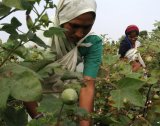 Hand-Harvesting |
Organic cotton represents a return to safe and sustainable practices. It is grown with natural fertilizers
and is free from toxic chemicals. Organic farmers rely on crop rotation to replenish and maintain soil fertility. Mechanical cultivation and botanical or biological means are used to control pests and weeds. A field must be pesticide-free for at least three years to be certified organic, and the cotton must be processed according to international organic standards. |
The standards also set strict guidelines for transportation and storage to avoid cross-contamination. In the U.S., cotton labelled as organic has to be certified by an independent agency recognized by the USDA's National Organic Program.
Some of the benefits of organic cotton are:
 |
|
|
Conventional farming endangers farm workers and their families. There are innumerable cases of serious pesticide-related health problems, including birth defects, long-term memory loss, paralysis and death. Unprotected storage, improper application methods and lack of proper handling is not uncommon, and often leads to tragic accidents.
As pests develop resistance, farmers desperate to keep up yields often resort to more and more applications of expensive pesticides. The chemical treadmill leaves them heavily in debt, and caught in a vicious circle. Facing barren, devastated fields and contaminated water, many small farmers have been forced to abandon their livelihood altogether. Organic farming, on the other hand, is not only safer and healthier for farmers, but also encourages just economic systems in the supply chain. It provides an economically viable and socially acceptable alternative to large-scale farming and dependence on subsidies. |
 Farmers' Families Benefit From Organic Practices |
F.A.Q.s
Q: I understand the benefits of organic food - but why should I buy organic clothing?A: Environmental changes affect each one of us. Organic farming could be a powerful ally in the race against global warming, not only as it consumes fewer resources to start, it is actually a powerful natural tool for carbon sequestering.
Conversely, on a small planet, we are all affected to some extent by the production and application of pesticides and poisons! You are closer than you think to the farms, chemical factories and waste treatment facilities that handle toxic chemicals used on your tee-shirt. By spending on organic products, you are using your consumer power wisely and adding your voice to the environmental movement.
On a purely personal level, even if you don't suffer from chemical allergies and sensitivities, you will most definitely feel better wearing pure, organic cotton against your skin.
Q: Is 'green' or 'natural' cotton the same as organic cotton?
A: In the US, 'green' cotton usually refers to cotton that is not bleached, dyed
or chemically treated during processing. However, it is grown conventionally, and falls short of organic.
Unlike the use of the word 'organic' in labeling, neither of these terms are regulated or certified,
so they may not always have a consistent meaning.
Q: With labor-intensive farming techniques, won't organic farming remain a more expensive alternative?
A: Organic farming appears less lucrative, only because the long-term damage of conventional farming is not quantified or taken into account. For instance, the millions spent to treat toxic residues can be saved if the problem wasn't created in the first place. Unfortunately, organic cotton gets little support from markets and financial institutions because it is considered more expensive. Over time, however, organic farms are more productive as the soil in is richer and more resistant to disease while the other is stressed and sterile due to chemical applications.
The difference in cost may remain, however, as organic producers have to pay for third-party certification whereas conventional farms often get subsidized chemicals and pesticides which off-sets costs.
In conclusion, we may end up paying more for organic products, but the pay-back is tremendous: better health for people, the planet and all her creatures.
http://www.panna.org and http://www.pan-uk.org The Pesticide Action Network is working to replace pesticide use with ecologically sound alternatives.
http://www.emagazine.com E - The Environmental Magazine, the Nation's only non-profit, independent consumer publication on the environment.